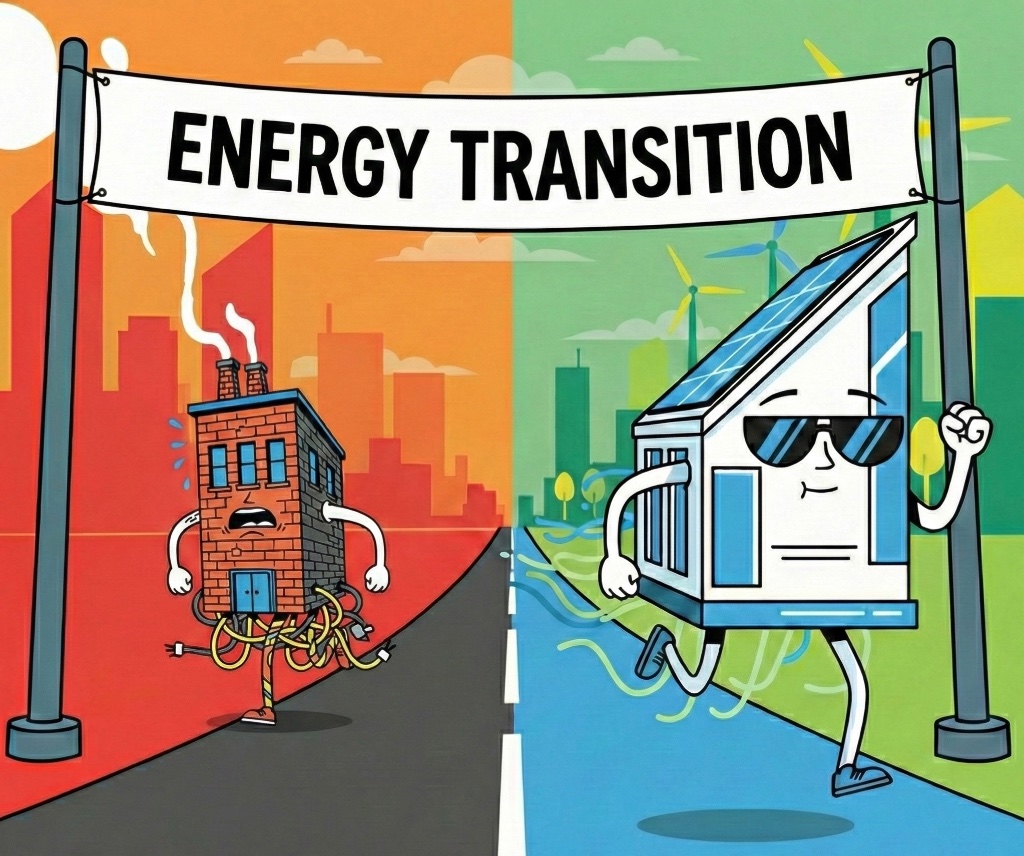
The European real estate sector is navigating a fundamental transition. On one side, the Energy Performance of Buildings Directive (EPBD) is mandating a zero-emission building stock by 2050. On the other, a volatile geopolitical landscape has exposed the fragility of centralized energy markets, and an aging grid infrastructure is struggling to keep pace with the electrification of heating (heat pumps) and transport (EVs).
Over the past 20 years, the conversation has shifted from "How do we buy cheaper power?" to "How do we generate, store, and manage our own?" The answer increasingly lies in Microgrids.
What is a Microgrid in a Real Estate Context?
At its core, a microgrid is a localized group of electricity sources and loads that normally operates connected to the traditional centralized grid, but can disconnect and function autonomously (in "island mode") as physical or economic conditions dictate.
For a commercial office park, a logistics hub, or a residential district, this typically comprises:
- Generation: Rooftop PV, small-scale wind, or hydrogen fuel cells.
- Storage: Battery Energy Storage Systems (BESS) or thermal storage.
- Demand: EV charging stations, HVAC, and lighting.
- The "Brain": An Energy Management System (EMS) that uses AI to balance supply and demand in real-time.
The Strategic Value Proposition: Why Now?
1. Energy Resilience and Energy Security
Europe's grid is under strain. In Germany and the Netherlands, grid congestion is so acute that new real estate developments are often denied connections for months or years. A microgrid allows a developer to "oversubscribe" their connection—using onsite storage to shave peak loads so they don't exceed their grid limit.
2. Decarbonization and "Green Premiums"
According to JLL research, "green" buildings in London and Paris command a rental premium of 7% to 11% over non-certified peers. Microgrids enable a building to maximize "Self-Consumption"—ensuring that every kWh generated by a solar panel is used onsite rather than sold back to the grid at a loss, directly lowering the building’s Scope 2 emissions.
3. New Revenue Streams
In the old model, energy was an OpEx line item. With a microgrid, it becomes a revenue generator. Through Demand Response programs, real estate owners can sell excess battery capacity back to the TSO (Transmission System Operator) during frequency fluctuations.
Financial Architecture: CapEx vs. OpEx
The transition to decentralized energy requires a fundamental shift in how we view the balance sheet.
The CapEx Burden
The "sticker shock" of microgrids is real. A comprehensive system for a 10,000 sqm commercial asset—including 500kWp solar, 1MWh BESS, and integrated EMS—can range from €800,000 to €1.5 million depending on the complexity.
- Hardware (50-60%): Batteries remain the largest cost, though prices have fallen over 50% in the past years.
- Soft Costs (20-30%): Engineering, permitting, and grid interconnection studies.
The OpEx Revolution
While CapEx is high, OpEx is significantly reduced or even "flipped."
- Reduced Energy Procurement: By shifting loads to mid-day (solar peak) and discharging batteries during evening peaks, buildings can reduce grid-bought energy by 40-60%.
- Maintenance: Modern EMS platforms are largely automated, but hardware requires periodic servicing.
- The "Energy-as-a-Service" (EaaS) Model: To circumvent high CapEx, many European developers are moving toward EaaS. Third-party providers fund the equipment, and the landlord pays a monthly fee lower than their previous utility bill.
ROI and Payback Periods
In the current European high-tariff environment, well-optimized microgrids typically see a Payback Period of 6 to 9 years.
Real-World Evidence: Europe’s Leading Examples
Example 1: The EUREF-Campus, Berlin
This 5.5-hectare innovation district is often cited as a global benchmark. By 2014, the campus had already reached the carbon reduction goals set by the German federal government for 2045. By integrating a microgrid that combines solar, wind, biogas-CHP, and one of Europe’s largest EV testing laboratories, the campus operates as a living laboratory for carbon neutrality.
- Key Data: It serves as a "virtual power plant," providing flexibility to the Berlin grid and significantly reducing peak-load costs for its 150+ tenant companies.
Example 2: Schiphol Trade Park, Netherlands
Faced with a completely congested grid (zero capacity for new connections), the park implemented a "Virtual Smart Grid." Companies share their power capacity through a decentralized platform. If one warehouse isn't using its full allocation, another can tap into it. This microgrid approach allowed the development to proceed where traditional grid constraints would have halted it entirely.
The "Pros and Cons" Analysis
Pros
- Grid Independence: Avoids grid congestion delays.
- Price Stability: Locks in energy costs for 20+ years, protecting against gas price spikes.
- Asset Valuation: Increases the Exit Value (Yield) of the property by improving the EPC rating.
Cons
- Regulatory Complexity: EU "Energy Sharing" laws are still maturing (though the Electricity Market Design reform is helping).
- Technological Risk: Rapid evolution of battery chemistries (LFP vs. Solid State) can make today's tech feel dated in 10 years.
- Interoperability: Getting legacy HVAC systems to "talk" to new batteries and EV chargers requires sophisticated software.
The European Regulatory Context
The regulatory environment is catching up to the technology. The EU’s Renewable Energy Directive (RED III) and the "Fit for 55" package are creating a right for "Energy Sharing." For example:
- France: New laws mandate solar canopies on large parking lots, making microgrids the logical next step for retail and logistics assets.
- Germany: The updated EEG (Renewable Energy Sources Act) has simplified the path for "tenant electricity" models, allowing landlords to sell onsite power directly to residents or businesses without being taxed as a traditional utility.
A Strategic Avenue for Real Estate Leaders
If you are an asset manager or developer, a path forward likely involves three steps:
- The Digital Audit: You cannot manage what you do not measure. Before installing a single battery, deploy an advanced Energy Management System to map your current "load profile."
- Modular Scalability: Don't build for 2040 today. Design your microgrid infrastructure to be modular. Start with PV and an EMS, and ensure your switchgear is "battery-ready" for when storage prices hit your target ROI.
- Tenant Alignment: Update your "Green Leases." Ensure that the benefits of lower energy costs are shared between landlord and tenant to justify the investment.
Final Thoughts
While the era of the "dumb building" isn't over yet, the competitive window for such assets is closing. Over the next decade, the most valuable real estate assets in Europe will be those that function as mini-power plants. Microgrids are no longer an experimental "sustainability" feature; they are a core risk management tool and a significant driver of Net Asset Value (NAV).
For those willing to navigate the initial CapEx and regulatory hurdles, the reward is an asset that is resilient, autonomous, and fundamentally aligned with the future of the European economy.
Sources & Further Reading: